The Lake & the Basilisk
A small steam-boat called the Basilisk carried up to ten passengers at a time around the lake. Punts, rowing boats and canoes were available for hire — the lake was, in its day, the centre of the Gardens' afternoons.


1838 to today
Long before the school existed, Swiss Gardens was a Victorian pleasure garden — boating lake, ballroom, theatre, fortune teller. The school sits on what's left of it. In 2008, the children renamed the school in its honour.
Why the name
In 2008, our school changed its name. It had been Shoreham First School. The children proposed a new name — Swiss Gardens Primary School — to honour the place that had stood here long before.
The school sits on land that was once part of a Victorian pleasure garden so popular that visitors travelled from Brighton and Worthing for an afternoon out. By the time the school was built, the gardens had fallen out of fashion, the buildings dismantled, the lake nearly gone. But the name remembers them.
Here's what was here.
The town and the river
Shoreham-by-Sea is a small port town on the West Sussex coast, where the River Adur meets the English Channel. The town is much older than the gardens our school is named for. Old Shoreham, a little inland, has roots that reach back to Saxon times — St Nicolas' Church, beside the river, still contains Anglo-Saxon stonework.
In the late 11th century, Norman lords laid out a new town at the river's mouth — New Shoreham — and built a magnificent harbour church, St Mary de Haura ("of the harbour"). For two centuries afterwards New Shoreham was one of the busiest Channel ports in England, until coastal erosion and the Black Death drained away its medieval prosperity.
From the late 1500s onwards, shipbuilding became the town's main industry. Twenty-one ships were reportedly built at Shoreham for King Charles I, and through the 19th century Shoreham-built vessels were known across the world's trade routes. It is no accident that the Swiss Gardens themselves were the work of a local shipbuilder.
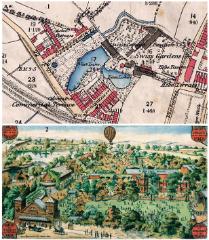
1838 · The opening
The land had once been a marsh. In 1782 it belonged to a shipbuilder called John Edwards, who knew it as David's Marsh. It later passed to his son-in-law, James Britton Balley — also a shipbuilder.
In 1838 — the same year as Queen Victoria's coronation — Balley turned the marshy plot into a pleasure ground with a Swiss-Alpine theme. Chalet-style timber buildings, a striking entrance lodge, and the name everyone knew it by: the Swiss Gardens.
It was an immediate hit. Local people gathered there for dinners, luncheons, anniversaries, anything worth marking. It became usual to round off a day of festivities with a gala-ball in the Gardens' magnificent ballroom — over eight thousand square feet of dance floor, which the local historian Henry Cheal considered probably the finest on the South Coast.
Some years before his death in 1863, Balley sold the Gardens to Edward Goodchild, for what Cheal records as "a very large sum". Goodchild and his family ran them through their busiest years — the railway-tourist era — when as many as five thousand visitors a day would step off the train at Shoreham, twice the resident population of the town.
“No charge is made for any of the amusements in the Gardens except a small one for: Billiards, Rifle Shooting and American Bowls.”
“Admission One Shilling, Children under ten years 6d.”
Plaque on the outside of the Swiss Garden, 19th century
From a period advertisement: "Swiss Gardens, Shoreham-by-Sea (near Brighton). Switzerland in Miniature. Open wet or dry during the summer." The poster showed a balloon ascending, the dancing pavilion, concerts and ballets on the open-air stage, and boating on the lake — with excursion-train returns from Brighton or Worthing thrown in. Period image pending — replacement sourced from local archives.
“The Swiss Gardens presented as great a variety of amusements as could be met with in any other place of its kind in England.”
Alderman Henry Martin · History of Brighton and Environs · 1871
What was there
A boating lake with a steam-boat called the Basilisk that could carry ten "Trippers" at a time. An observatory tower shaped like a lighthouse. A grotto guarded by stone giants. A fortune teller. Six ship's cannons. Here are some of the things you'd have found, paying your shilling at the gate.
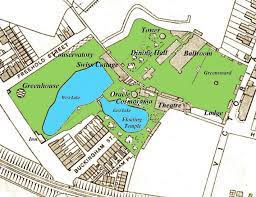
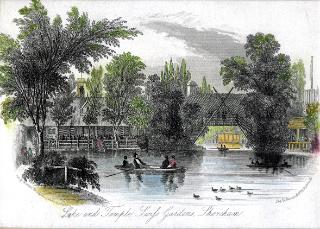
A small steam-boat called the Basilisk carried up to ten passengers at a time around the lake. Punts, rowing boats and canoes were available for hire — the lake was, in its day, the centre of the Gardens' afternoons.
Eight thousand square feet of dance floor — "probably the finest on the South coast", per the local historian Henry Cheal. People came from Brighton and Worthing for the dances and fetes held here.
Private boxes, a pit and a large gallery. "Both neat and commodious", said the Illustrated Times in September 1858. Performances started at 2pm — concerts, singing, comedians, then early photographic shows in the late afternoon.
A grotto containing a Chalybeate Spring, surrounded by roses and honeysuckle, its entrance guarded by large stone giants. A "Bridge of Steps" spanned the stream nearby. Through a low door covered in mystical characters, you could consult the Lady of the Temple of the Oracle — a fortune teller.
A high observation tower shaped like a lighthouse, with as many steps to climb. From the top you could see the whole Gardens and the surrounding area.
A battery of six carronades — a kind of ship's cannon — would occasionally sound off to start an event on the sports field: a balloon ascent, the start of a firework display, or simply for the entertainment of the crowds.
A bowling green, an archery field, and a cricket pitch — used for matches as well as the firework displays and balloon ascents that drew the biggest crowds.
Scrap books and albums for visitors. Tables with chess sets, draughts and boards — all free of charge. An adjacent saloon for bagatelle, Chinese billiards, and other "scientific games".
1905 onwards
By the late 1890s, the Gardens had begun to fall out of fashion. Seaside resorts were drawing the day-trippers away, the entertainment was getting rougher, and the buildings had begun to decay. The Swiss Gardens closed to the public in 1905. By 1910 (around 1909) most of the remaining structures had been pulled down and the overgrown site cleared.
Part of the cleared ground was sold to the local council for a school. More went for housing. Children who had once trespassed through the abandoned grounds now found themselves studying on top of where the lake, ballroom and theatre had stood.
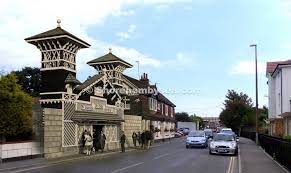
Around 1928 the Swiss Cottage public house was built — and rebuilt — on what had been one of the gardens' main entrances. The chalet-style timberwork of the new entrance lodge, set on the Old Shoreham Road frontage, deliberately echoed the Alpine theme Balley had given the gardens nearly a century earlier. The pub still stands.
A fragment of the original boating lake survives behind it. Mature trees on the school's boundary date from the gardens era. Beyond those, what's really left of the original Swiss Gardens is the school building itself — and, since 2008, the school's name.
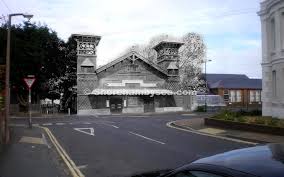
A short timeline
Two centuries of one Shoreham plot — from David's Marsh to a Victorian pleasure ground to a primary school.
| 1782 | The marshy plot known as David's Marsh belongs to the shipbuilder John Edwards. It later passes to his son-in-law, James Britton Balley. |
|---|---|
| 1838 | Balley opens the Swiss Gardens — a Victorian pleasure ground — in the year of Queen Victoria's coronation. Admission one shilling. |
| c.1843 | The boating lake is enlarged. The grounds boast a ballroom, aviary, library, ornamental gardens and sporting facilities. |
| 1858 | A reporter for the Illustrated Times describes the new theatre as "neat and commodious", with private boxes, pit and gallery. |
| Before 1863 | Balley sells the gardens to Edward Goodchild for, it is said, "a very large sum". |
| 1880 | John Jellicoe's engraving of the Gardens is published in the Illustrated Sporting and Dramatic News. |
| 1905 | The Swiss Gardens close to the public after Victorian seaside fashions move on. |
| c.1909 | The remaining buildings are dismantled and the overgrown site is cleared. |
| c.1928 | The Swiss Cottage public house, on the original gardens entrance, re-opens with a new Swiss-style lodge on the Old Shoreham Road frontage. |
| 2008 | The local primary school, formerly Shoreham First School, is renamed Swiss Gardens Primary School — chosen by the children to honour the site's past. |
Notable people and visitors
James Britton Balley
Shoreham shipbuilder, founder of the Swiss Gardens in 1838. The man whose vision still gives our school its name.
John Edwards
Balley's father-in-law. Owned the marshy plot known as David's Marsh in 1782, before the gardens existed.
Edward Goodchild
Bought the gardens from Balley some years before 1863 and ran them through their busiest railway-tourist years.
Henry Cheal
The great local historian of Shoreham, whose writings preserved many of the gardens' details after they had closed.
John Jellicoe
Illustrator whose engraving of the Gardens appeared in the Illustrated Sporting and Dramatic News in October 1880.
The pleasure-seekers
Up to five thousand on busy summer days — the unnamed Victorian day-trippers who travelled by train from Brighton, Worthing and London to spend the day in Shoreham.
Go deeper
If the story above grabbed you, there's more. A local history video on YouTube traces the Gardens in pictures and old prints; the Shoreham By Sea archive has a longer written account.
A fuller account of the early years of the Swiss Gardens, plus a separate piece on the Swiss Cottage pub. Written for the local-history community, with more on the people, the era, and the ones who made it happen.
The Victoria County History of Sussex entry on Old and New Shoreham (British History Online) covers the medieval town, the harbour churches and the shipbuilding era. The school's own Swissistory page on the live site keeps a longer-form version with more photos.
Five historic images appear on this page. The "then and now" overlay and the Victoria Road entrance photograph appear on shorehambysea.com. The lake engraving, the labelled pleasure-park map, and the combined map-and-view come from local 19th-century publications and the school's own heritage archive. Wikimedia Commons photographs of St Mary de Haura, St Nicolas' Church, the Swiss Cottage pub frontage and the River Adur (referenced in the text) can be added under their CC BY-SA licences in a future iteration with proper attribution. For pre-launch use: licensing or explicit permissions for the Bridgeman archive image and the shorehambysea.com photographs to be secured before this page is publicly published.
If the story above made you curious, come and see what the school is now. Contact the school office to arrange a visit.